
Topsoil vs Fill Dirt: Which Material Fits Your Project?
Choose soil by the job it must do: support roots, build up the ground, or both in separate layers. Here is what to ask before ordering a load.
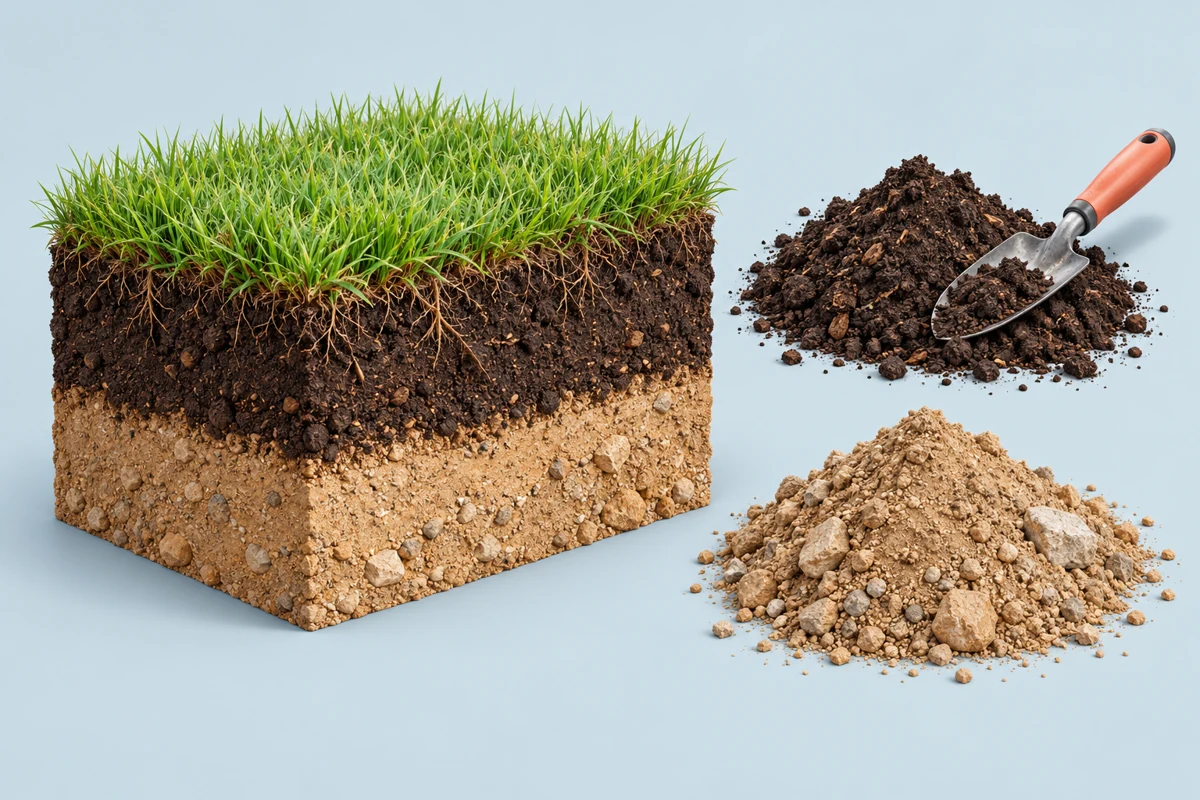
The practical difference in topsoil vs fill dirt is what you are buying the material to do. Topsoil is selected for a growing layer. Fill is selected to add volume or establish a specified grade. A product name alone does not prove either material is suitable for your site.
Start with the finished surface
| Your task | What to look for | What the name does not guarantee |
|---|---|---|
| Prepare a growing layer for a lawn or planting area | Topsoil suited to the plants and existing soil | Good texture, suitable pH or freedom from contamination |
| Raise a substantial low area, then grow grass | Suitable fill below a separately planned growing layer | That one load of generic dirt can do both jobs |
| Support a slab, pavement or structure | The fill and placement requirements specified for that project | That ordinary “fill dirt” qualifies as engineered fill |
| Fill a raised vegetable bed | A suitable growing-soil blend, with its ingredients identified | That unamended excavated fill is an appropriate growing medium |
For a shallow lawn depression, first establish why it is there. Adding soil will not resolve an underlying drainage or continuing settlement problem. Around buildings, changing levels can also change where water flows; choose the grading plan before choosing a truckload.
Topsoil and fill dirt vary between suppliers
Natural topsoil is the upper soil horizon. Commercial products sold under that name can include excavated soil or blended material. Utah State University Extension identifies texture, salts, pH, organic matter and coarse fragments among the properties that affect its usefulness. A dark color is not a soil test.
Fill dirt may contain different proportions of sand, silt, clay and stones. It should not be described as automatically drainable, stable or suitable beneath a foundation. “Clean,” “screened” and “engineered” answer different questions; ask the supplier what each term means for the actual load.
Does screened topsoil mean better growing soil?
Screening removes material larger than the screen opening, such as some stones and clods. It can make soil easier to spread and finish. It does not establish its nutrient content, salt level or contamination history. Ask for the screening size and available analysis rather than treating “screened” as a complete quality certificate.
If the job needs both, order two defined layers
Imagine a 120 ft² area where a project plan calls for 10 inches of added depth: 6 inches of suitable fill and 4 inches of growing soil. Those depths are an arithmetic example, not a recommended soil profile. The fill occupies 60 ft³ and the growing layer occupies 40 ft³. Ordering 100 ft³ of topsoil would purchase the entire volume as one material.
Keep those quantities separate when asking for a quote. They describe the planned space, not automatically the loose amount to deliver. Ask how the specified fill will be placed and how the supplier expresses the sale quantity. Do not apply an arbitrary “settlement percentage” to both layers.
Once the layer depths are decided, use the topsoil calculator for each volume separately. A quantity result cannot determine which material belongs below a structure or what compaction the project needs.
Ask for a sample and the load's history
- Where did it come from? Ask whether the load is excavated soil or a blend, and what was added.
- What information supports the intended use? For growing soil, request relevant test results; for specified fill, request the documentation required by the project.
- What is excluded? Agree on expectations for roots, rubble, oversized stones and other debris. Visual inspection cannot rule out chemical contamination.
- How is it sold? Confirm volume or weight, delivery access and the material you will receive—not merely the display sample.
For planting work, compare purchased soil with what is already on site. Improving the existing growing soil may be more useful than replacing it with an unverified load. For raised beds, University of Maryland Extension discusses a topsoil-and-compost approach; that is a growing-medium decision, not a reason to use compost as structural fill.
Sources
Utah State University Extension: topsoil quality guidelines explains soil properties, sampling and the limits of visual assessment. University of Maryland Extension: soil to fill raised beds addresses growing-soil selection. The two-layer quantities above are an original worked example.
More guides for your project
All guides